A World in Recovery
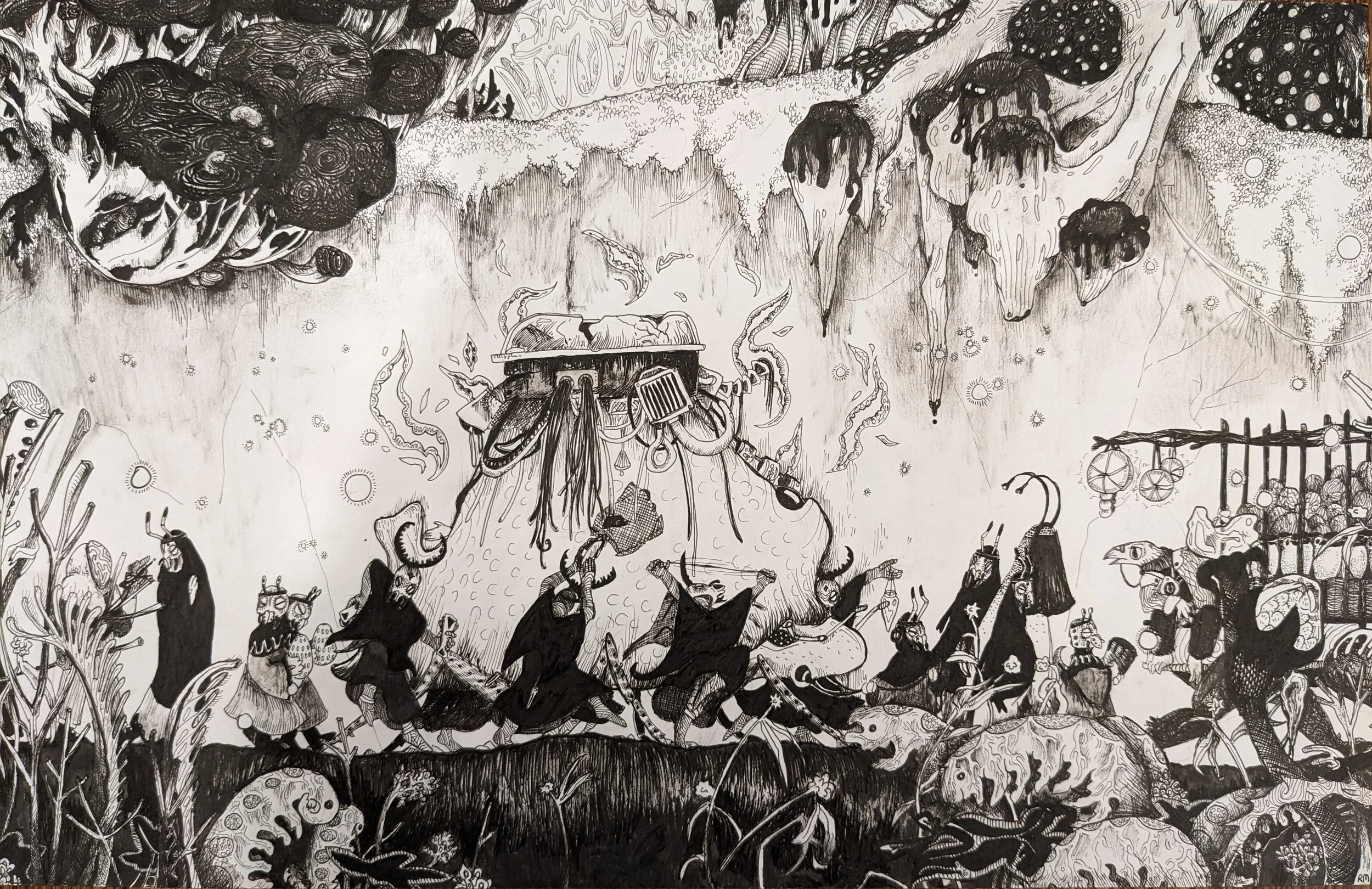
Rowan Magnell’s To the Termite Mound is an illustration developed for a story set in a poisoned world. In this imagined landscape, mutating forms of magic stem from ancient pollution, while caskets containing sleeping figures remain buried underground until the land has healed itself.
Aboveground, new groups have established themselves in the altered environment. The Termite Cult, the focus of the drawing, is one of these groups. The work explores its presence within the larger world through movement, environmental detail, and the interaction of its figures.
Completed Series
A road cutting through a forest, overhung with giant mushrooms and bordered with ferns. A procession centered around a giant beetle with a broken casket on its back occupied most of the drawing, while more everyday merchants and travelers interact with the processional figures in front and behind.
The drawing is therefore not an isolated image. It is part of a developing narrative setting, one shaped by environmental collapse, contamination, recovery, and the social structures that emerge in their wake. Magnell used the piece both to investigate this fictional world and to test a new visual direction informed by Gothic fiction, black-and-white film, and ecological ruin.
Materials and Linework
Magnell completed To the Termite Mound over two weeks, working between their school’s art studio and home. The drawing predates their use of dip pens, so the linework was made entirely with Sakura Micron pens.
An old brush pen, nearly dried out, was used to develop areas of shading and texture. Its limited condition became part of the drawing’s surface language, producing marks that differ from the more controlled Micron lines.
The materials support the work’s black-and-white atmosphere. Rather than relying on color to establish mood, Magnell develops density, contrast, texture, and depth through line. The result aligns with the Gothic and cinematic references that informed the piece while maintaining the specificity of its invented world.
Starting with a World
For Magnell, the work begins with a world before it begins with a single image. Sometimes that world is Earth. More often, it is fantastical or futuristic, shaped by its own environments, histories, and systems of life.
These worlds may develop into stories or remain as static settings, and that distinction guides the resulting artwork. Because To the Termite Mound belongs to an ongoing story, it contains a substantial amount of environmental activity. Characters move through a larger setting that is meant to imply social relationships, ongoing labor, and a history extending beyond the image’s frame.
Once Magnell identifies the focus of a drawing, they begin with sketches and compositional variations. When a composition feels established, it is transferred as a light pencil sketch onto the final paper before the first linework begins.
Composition, Improvisation, and Detail
Magnell describes their process as primarily intuitive. They prefer to begin quickly and discover what happens through drawing, but use sketches and impermanent materials to prevent intuition from making the work too rushed or irreversible.
The composition usually remains stable across the process, unless it becomes intolerable during the final sketching stage. What changes are the small, local decisions: the angle of an arm, the contents of a wagon, the form of vegetation, or the fronds of a plant.
These details are not fully resolved in the early sketches. Instead, they emerge when Magnell reaches them on the page. The process allows the world to remain open while preserving a clear structural framework.
The final linework is where mistakes become consequential. Marks may need to be reworked, disguised, or incorporated into the drawing’s surface. This is also the stage at which Magnell works against their own urge to finish too quickly. The challenge is to preserve the spontaneity of the initial impulse while giving the drawing enough time to become precise.
In To the Termite Mound, that balance allows a detailed narrative environment to remain active rather than overdetermined. The fictional world is carefully built, but its small elements retain the improvisational energy of being discovered as the drawing unfolds.