Mulin Chen: City, malfunction
New York Under Algorithmic Pressure
Mulin Chen’s City, malfunction imagines a parallel metropolis in which the raw atmosphere of late twentieth-century New York intersects with the less visible systems of contemporary artificial intelligence. Rain-slicked streets, analog texture, newspapers, and anonymous figures are subjected to digital distortion. Familiar urban scenes warp, dissolve, and appear to malfunction in public.
Completed Series
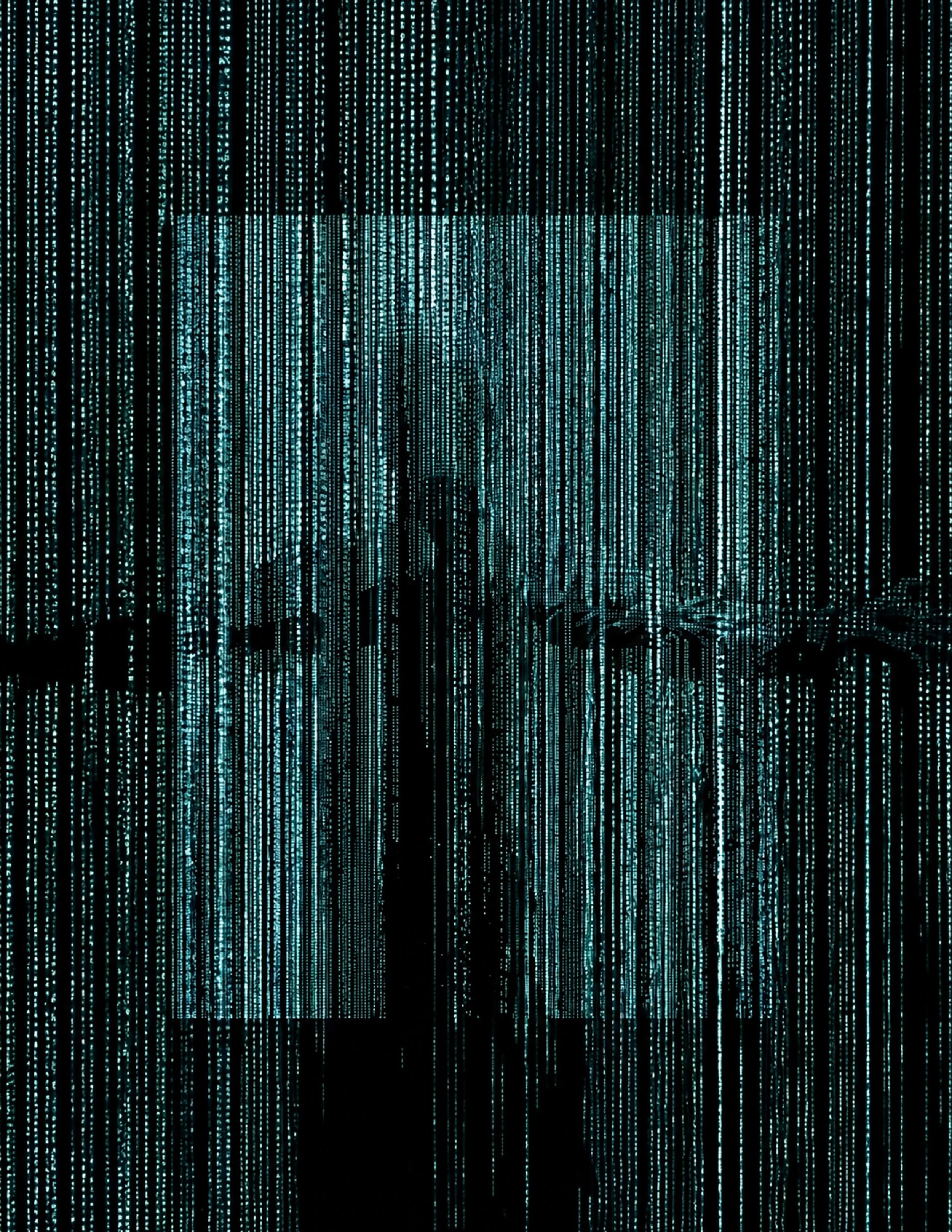
A solitary human silhouette is caught within a dense, curtain-like cascade of teal digital code and vertical static rain. Framed by a darker central rectangle, the figure appears to be glitching and dissolving directly into the surrounding data stream, evoking a sense of digital erasure.
The series is informed by Chen’s nearly decade-long experience living in New York and by an interest in the visual character of 1980s New York City. Rather than reconstructing that era as nostalgia, Chen places it in friction with a simulated future. Newspapers become fluid forms, figures break into data streams, and the city’s apparent physical stability is interrupted by algorithmic interference.
Chen began the project in 2022, following the emergence of AI tools such as Midjourney. Developed over three years and completed in 2025, the series asks where the memory of New York might end and a technological simulation might begin. The work considers how rapid shifts in image-making technologies affect a city and the people moving through it.
From Draft to Digital Image
As a systems-trained 3D and VFX artist, Chen developed City, malfunction through a workflow that moves from digital drawing drafts to AI-assisted image generation, then through extensive editing in Adobe After Effects and Adobe Photoshop. The work is not treated as a single generated output. It is constructed through a sequence of decisions involving drawing, generation, compositing, layering, color grading, and revision.
Each work begins with a clear visual concept: translating an abstract human experience into a surreal visual language. René Magritte’s 1953 painting Golconda was a key point of reference for one of the series’ central images. Chen adapted the idea of an anonymous, repeated figure into a silhouette that could stand for anyone, or no one in particular, submerged within and emerging from digital rain.
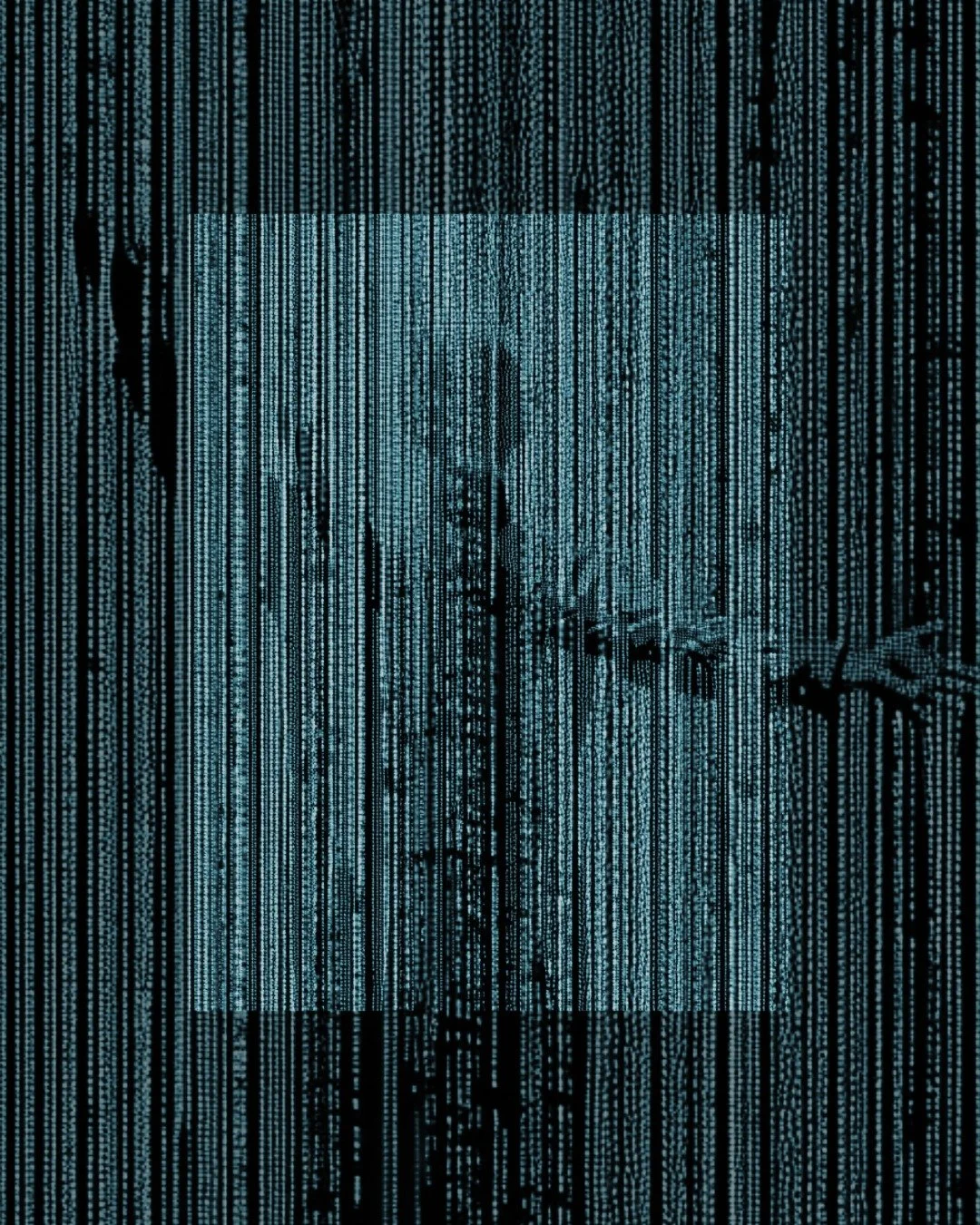
The earliest version was a flat, single-layer image dominated by monochromatic blue. It operated as a conceptual blueprint, focused primarily on placing the silhouette within the rain. The work’s eventual depth was not present at this stage. Its key elements existed, but its space had not yet been destabilized.
Building Glitch Space
Following AI-assisted generation, Chen brings the image into After Effects and Photoshop to construct multiple semi-transparent layers. Digital static, code streams, geometric masks, and repeated video passes are added gradually, creating depth and spatial distortion.
The central silhouette remains constant throughout this process. It functions as a universal cipher for human identity, while digital immersion remains the work’s thematic anchor. What changes is the space around it. The flat composition and simple two-dimensional field are quickly abandoned in favor of an immersive, layered visual environment.
Chen’s process moves through several structural phases. A foundational video pass establishes the silhouette and the movement of the digital rain. Secondary passes are then scaled down and delayed by half a second, creating a subtle temporal offset that makes the figure and surrounding space seem to float between dimensions.
Behind Chen’s process
In the final stages, Chen stacks timecode stills and video layers, adjusting opacity, scale, position, color balance, and blending modes. The aim is a semi-transparent depth that feels breathable and integrated rather than mechanically assembled. Geometric frames and vertical rain streams become a means of structuring the image while keeping it in motion.
Limits Within Digital Abundance
The process combines intuitive visual judgment with methodical technical execution. Chen remains open to changes produced through experimentation, but the work is guided by a fixed conceptual concern: human identity submerged within technological systems.
Working entirely in digital software introduces a particular problem of excess. There are effectively endless available options, and Chen addresses that condition by setting strict limits. Color palettes are restricted to cool tones, while geometry is constrained to precise rectangular frames and vertical streams of rain.
These limitations are not merely stylistic. They turn technological parameters into compositional boundaries, forcing Chen to rely on small adjustments in transparency, timing, and spatial layering rather than adding more visual information.
Chen also steps away from a piece for several days at a time, returning with a reset eye. A work is resolved not when it reaches technical perfection, but when its atmosphere aligns with the original conceptual intent.
The introduction of temporal offsets and geometric framing is the most consequential formal shift in City, malfunction. These decisions move the work from a straightforward graphic image into a multidimensional digital space, where New York’s remembered texture and a simulated visual future coexist without fully settling into one another.