Xia Liu: Flat Sand is Boundless
Land, Technology, and an Unproductive Garden
Xia Liu’s Flat Sand is Boundless is an installation and performance work that considers the relationship between environment and human society through a deliberately unstable landscape. Sand covers the floor, ceramic vegetables occupy the space, and a modified Roomba robotic vacuum moves continuously among them with a projector mounted to its body. Together, these elements bring home, land, agriculture, technology, labor, and time into the same field.
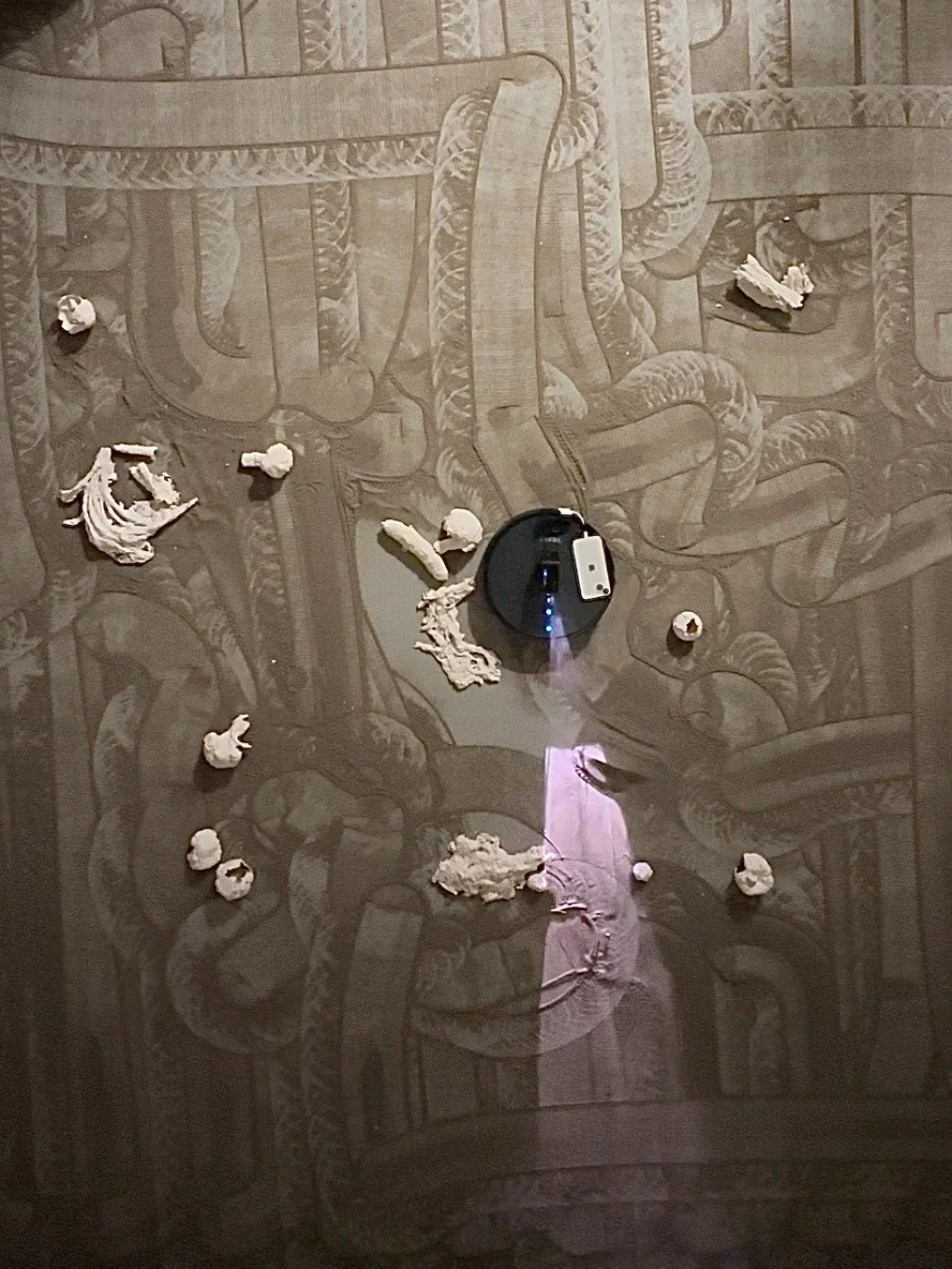
Completed Series
The final version of Flat Sand is Boundless.
The ceramic vegetables are hollow forms made by coating real vegetables in mud and firing them. They retain the surface memory of organic matter while becoming inert objects. In the sand, they resemble a garden but cannot grow. Their presence establishes what Liu describes as a landscape of “beautiful futility”: forms associated with cultivation and nourishment placed in a material that cannot sustain life.
The work began with memories of Liu’s grandmother’s vegetable garden. Growing up with grandparents in a rural village in China, Liu knew the garden as a small, cultivated plot shaped by seasonal work, care, and the accumulated labor of generations. The soil held a particular sense of duration, carrying the traces of those who had worked it before.
That memory became the basis for a work about land not as a neutral setting, but as a record of use, attention, and continuity. Flat Sand is Boundless does not recreate the garden. It places its associations of fertility and care beside materials and systems that cannot produce the same outcome.
The Roomba as a Redistribution Device
At the center of the installation is a Roomba robotic vacuum modified to move through the sand rather than collect it. Liu opened a large aperture in the machine’s collection box, allowing sand to pass continuously through it. Instead of cleaning the floor, the Roomba redistributes material as it follows its programmed path.
The alteration was technically demanding. Liu tested five Roomba units during development, as the abrasive sand caused significant damage to the machines over time. The final modification allows the performance to continue for approximately two hours, until the battery is depleted.
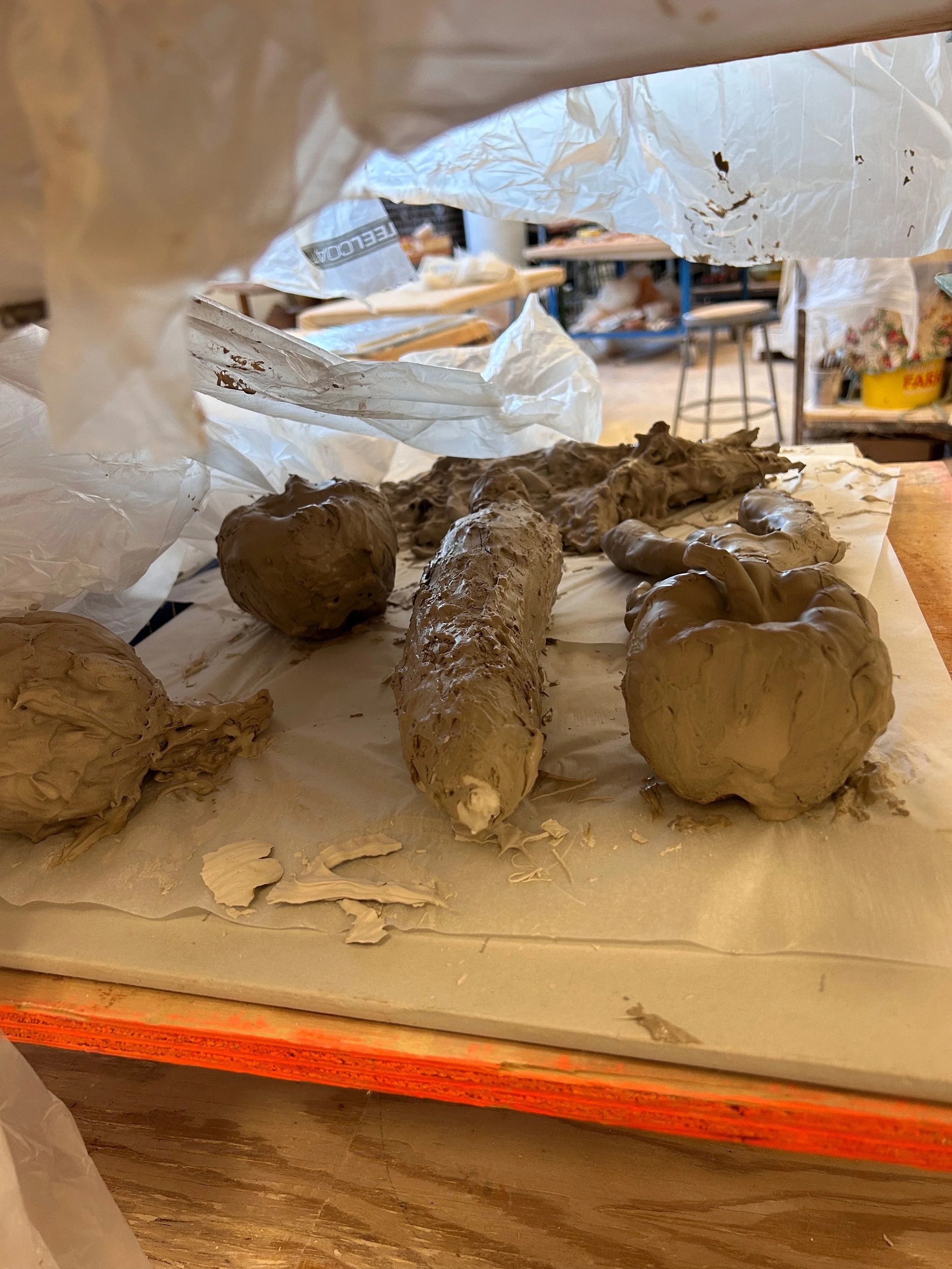
Early Work
The exploration stage of early materials.
The Roomba’s movement is neither fully controlled nor random. It follows its own internal logic, repeatedly crossing the floor and producing marks, small drifts, and changing patterns. The total amount of sand remains constant, but its form is continuously rearranged. A projector mounted on the machine moves with it, casting light that shifts across the space according to the robot’s path rather than a human operator’s decisions.
This transformation of the Roomba’s function is the work’s most significant technical and conceptual decision. A device designed to remove matter from a surface becomes one that endlessly redistributes it. The machine does not resolve disorder. It produces another kind of order through repetition.
Beginning with Sand
Liu’s practice usually begins with material research. Before a full conceptual framework is established, she investigates a substance, object, or phenomenon through its behavior, latent properties, and potential within a work. In this case, the starting point was sand: its weight, texture, geological age, and resistance to containment.
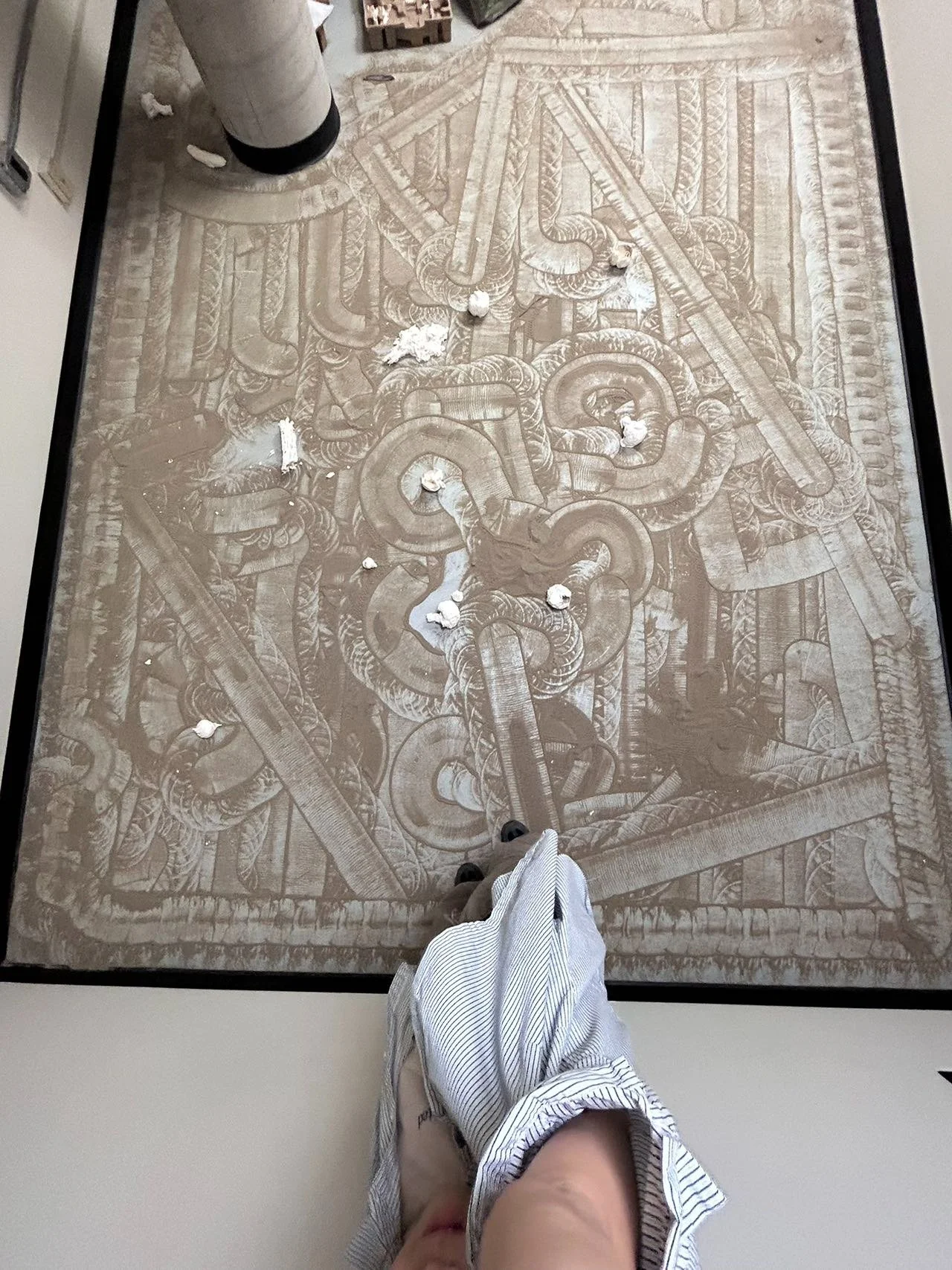
Work in Progress
I tried to repeatedly test and modify in the space.
The earliest version of Flat Sand is Boundless was simple. Sand was scattered across the studio floor and a Roomba was set loose within it. There were no ceramic vegetables, no projector, and no alteration to the machine. The initial test established the central encounter between automated movement and unstable material.
Watching the Roomba cross the sand made the importance of duration immediately clear. The machine left marks that accumulated and changed over time. Its behavior produced a surface that could not be fixed in a single image, and the project began to develop around repetition, alteration, and sustained viewing.
Liu’s process is intuitive but not unstructured. She begins by responding physically and perceptually to materials, placing things together and observing what happens before identifying a complete conceptual system. “Thinking happens through making,” she explains. The ceramic vegetables emerged through the desire to introduce something that appeared organic but could not grow. The projector came from an existing interest in light as a medium, and its placement on the moving machine established another layer of movement and duration.
Testing, Attrition, and Resolution
The work moved through several distinct stages. The first involved testing different quantities and distributions of sand against the Roomba, learning how the material affected the machine’s movement and tolerance. The second introduced ceramic vegetables as obstacles, examining how the Roomba encountered and navigated their rigid forms.
A third phase added the projector and focused on the changing spatial effect of moving light. The final stage centered on the collection-box modification, with Liu calibrating the relationship among sand volume, flow rate, machine behavior, and performance duration. The two-hour cycle emerged through this process of adjustment.
Repeated testing was central to both the making and the meaning of the work. Liu ran the performance again and again, changing variables, observing what altered, and identifying what remained consistent. The work felt resolved when its technical behavior and conceptual stakes became inseparable. The sand passing through the modified collection box was no longer merely a practical solution. It became a material statement about circularity, change without loss, and continuity beneath transformation.
The damage to the Roomba units became part of this logic. The machines wore down through sustained contact with sand, making material attrition visible within the work’s development. This was a genuine limitation, but it also reflected the concerns already present in the installation: use, time, the cost of sustained labor, and the material effects of repetition.
The ceramic vegetables perform a different kind of resistance. They cannot move or be cleanly swept away, and they remain as obstacles while the sand changes around them. Their rigidity reinforces their symbolic role as persistent forms within a shifting environment.
Duration and Generational Continuity
Flat Sand is Boundless was developed over approximately two months, from early research and testing through the final performance and documentation. The extended studio process allowed Liu to observe the work under different conditions, including changing ambient light and varying states of attention.
The performance’s two-hour duration also asks something of its viewers. It cannot be fully understood in an instant. Patterns change gradually, light travels, sand moves, and the machine wears itself into the work. The installation’s sense of time is cumulative rather than dramatic.
Liu’s initial concern with land, time, and generational continuity remains present throughout the final work. The garden that prompted the project is not represented as a nostalgic image. Its underlying questions are translated into a system in which materials are moved, retained, damaged, and reconfigured. The work places human care, automated labor, and environmental limits in direct relation, allowing each to shape the others.