Vandorn Hinnant: Twenty PHI Plus
A Diagram Developed Through Dialogue
Twenty PHI and Twenty PHI Plus emerged from an extended visual dialogue between Vandorn Hinnant and retired physicist Robert L. Powell, Sr. (1923-2015). From 1989 onward, the two exchanged hand-drawn geometric diagrams in response to a shared question: “What next?”
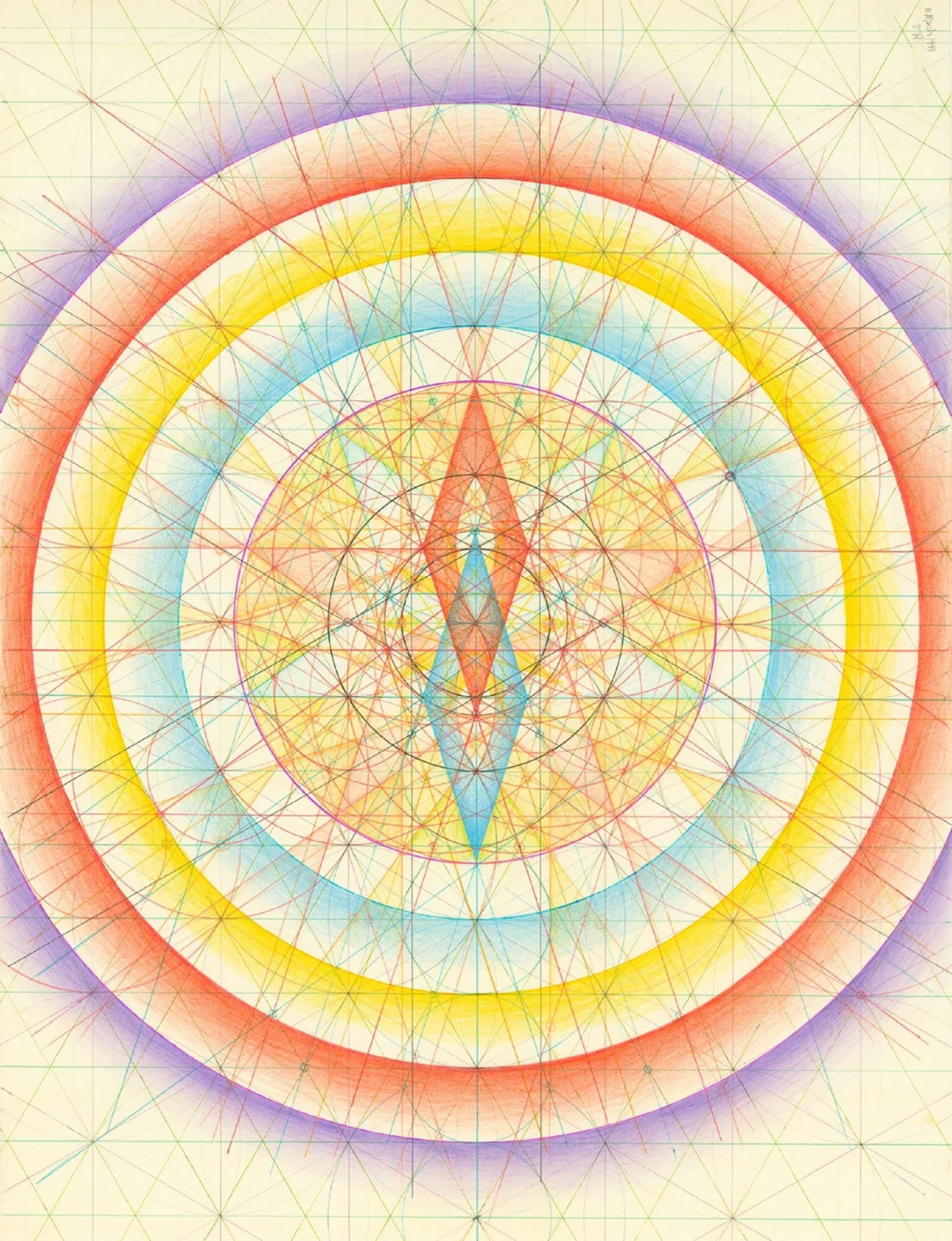
Completed Series
"Twenty PHI Plus" is a geometrical drawing created on paper with a circle drawing compass, straightedge, graphite, inks, and prismacolor pencils.
The exchange was cumulative. Each new drawing answered, extended, or complicated the previous one, creating a sustained practice of visual inquiry. Hinnant compares the process to a tennis match, a continuing volley in which neither participant could fully determine the next move in advance.
Twenty PHI was created during a winter 1999 retreat in Sugar Mountain, North Carolina, attended by Hinnant, Powell, and others. The work grew from a decade of conversation and experimentation at the G. R. Lomanitz Visual Mathematics Laboratory of P.S.I. Inc. in Houston, where Hinnant and Powell explored symmetrical diagrams that echoed patterns they observed across mineral, plant, and animal life.
Powell’s background in physics remained an important context for these exchanges. His work in non-invasive holographic interferometry informed the wider intellectual atmosphere in which the diagrams developed, particularly their attention to symmetry, structure, and the translation of complex phenomena into two-dimensional form.
Constructing Twenty PHI Plus
The foundation of Twenty PHI is a two-dimensional plane populated by unit circles, each sharing its radius with a neighboring circle. From this arrangement, Hinnant employs a precise geometric strategy to establish four five-pointed stars that share a common center.
Each star is oriented toward one of the cardinal directions: north, east, south, and west. For Hinnant, these orientations acknowledge the four directions recognized by numerous ancient cultures, while also establishing a strong internal order within the composition.
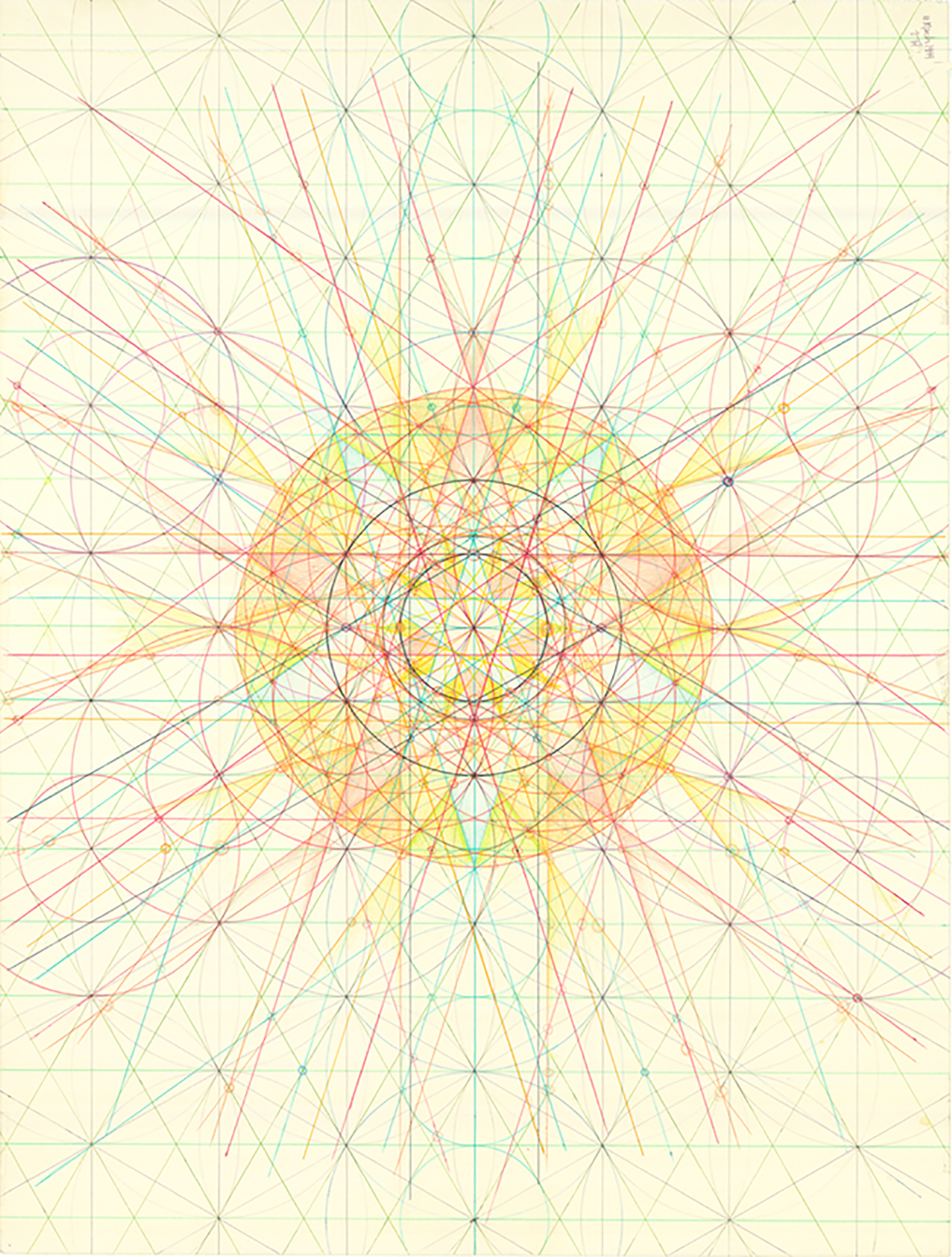
Early Work
The composition "Twenty PHI" is what "Twenty PHI Plus" grew out of.
Twenty PHI Plus develops the earlier drawing through color. Color coding distinguishes the four primary five-pointed stars and the smaller stars nested within them. Four larger color-coded circles, concentric with the circle enclosing the central stars, further organize the diagram and clarify its layered relationships.
The works are made by hand using a circle-making compass, straightedge, graphite, ink pens, and Prismacolor pencils. This manual process is significant to Hinnant’s practice. It keeps the work close to its material construction, even as the diagrams address abstract systems of proportion, symmetry, and spatial relation.
Process and Method
Unlike many of Hinnant’s compositions, which begin on sheets already prepared with acrylic washes, Twenty PHI began on a blank page. It remains unusual within the artist’s body of work because of its four identical five-pointed stars, each sharing a center while facing a different direction.
Hinnant describes much of his process as beginning from a place of surrender, sometimes understood as a meditative state. In this instance, the work was also shaped by collaboration. Although the final drawing is Hinnant’s, it carries the accumulated influence of a long exchange with Powell and the shared investigations that preceded it.
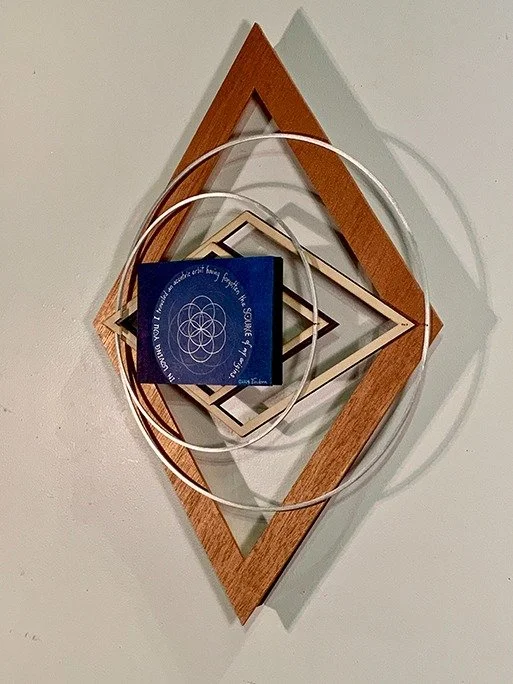
Work in Progress
An assemblage, "Something To Do With LOVE", part of my MEMORY PORTALS Series, integrates six-fold symmetry with the Golden Ratio.
Twenty PHI Plus was created approximately ten years after the initial 1999 diagram. It is therefore both a continuation and a reconsideration. Rather than repeating the original work, Hinnant revisited its underlying structure, using color to make its distinct components more visible and to extend the logic of the earlier image.
Geometry, Perception, and the Artist’s Framework
Hinnant’s work is informed by Euclidean geometry, as well as traditions sometimes described as sacred geometry or the geometry of art and life. His interest in these systems has led him to study artists and thinkers associated with geometry as a means of understanding natural order, including Leonardo da Vinci and Albrecht Dürer.
He sees a divide between institutional approaches to physical science and approaches to consciousness, perception, and nonmaterial experience. His own work is shaped by a long personal engagement with what he describes as naturally occurring paranormal experiences. Rather than treating the diagrams only as formal compositions, he understands them as visual documents of experiences that have influenced his life and creative practice.
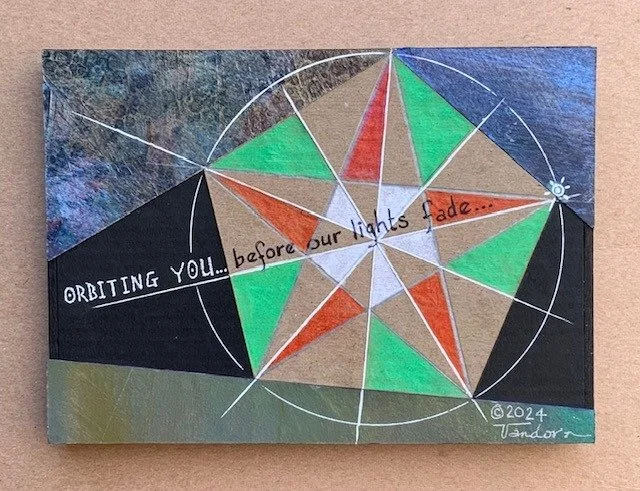
Additional Highlights
"I Am a Satellite in the Constellation of Your Dreams" is a small 5" x 7" collage/construction created for a group exhibition at the Satellite Gallery in December of 2024. This work, featuring a multifaceted five pointed star, has since become integrated into a much larger construction/assemblage as part of a series I have titled "MEMORY PORTALS" which employ my writing as a central element in each work.
Within this framework, the images can function as “windows” or “portals,” inviting viewers to consider forms of awareness that extend beyond ordinary spatial and temporal reference points. The language is intentionally expansive, but the works remain grounded in the visible discipline of geometry: circles, stars, directional orientation, color, and the carefully measured relationship of one line to another.
For Hinnant, Twenty PHI Plus is not a closed system. It is an artifact of an ongoing inquiry into symmetry, collaboration, perception, and the visual possibilities of a page.