Twenty PHI Plus
by Vandorn Hinnant
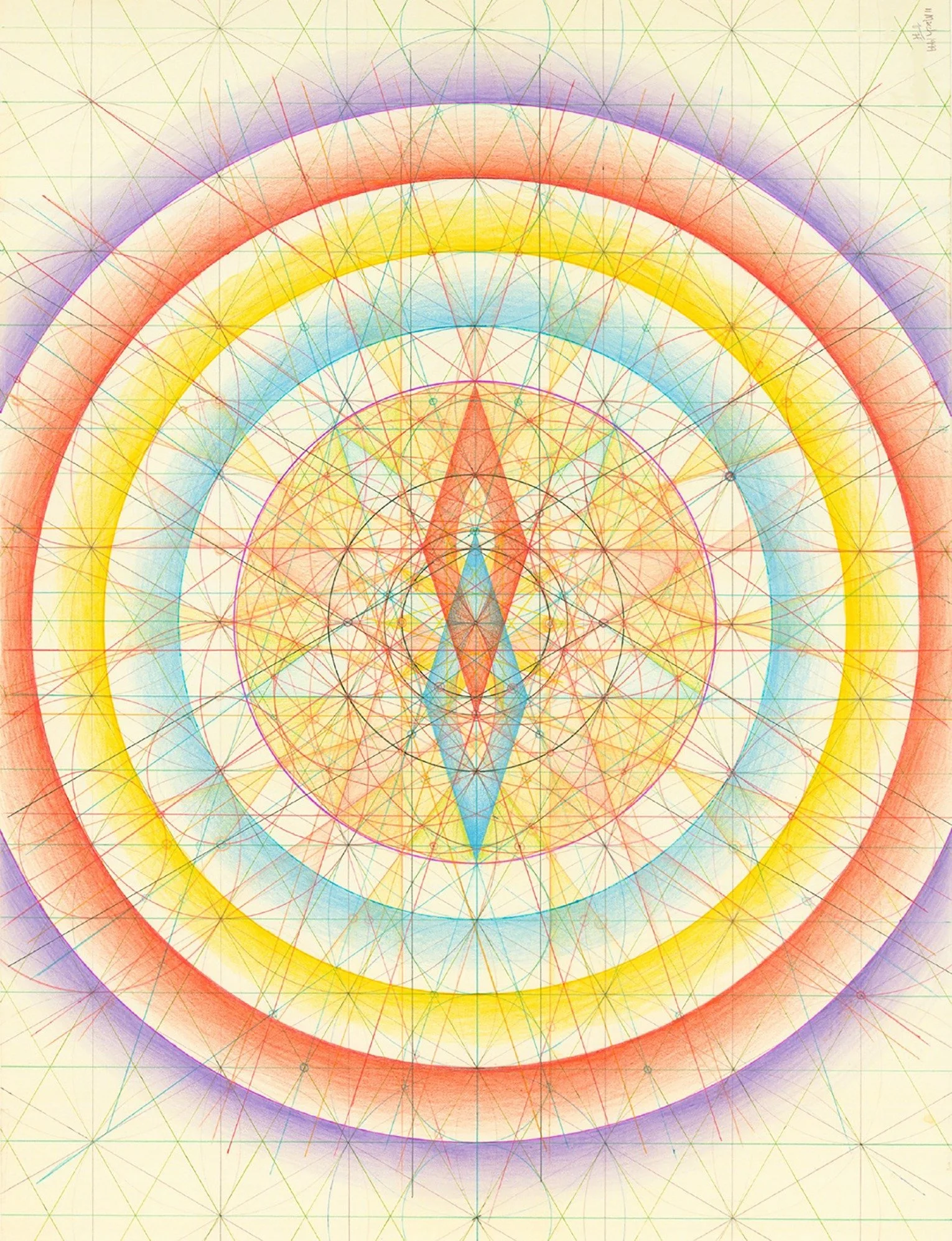
“The drawing “Twenty PHI” grew out of a dialogue in 1999 between me and my mentor, retired establishment physicist Robert L. Powell, Sr., who was responsible for bringing non-invasive holographic interferometry to the forefront of scientific investigation during his research years. He and I began a geometry centered conversational dialogue in 1989 which rapidly grew into an extended dialogue where we would share our latest geometrical drawings with one another and respond with a newly discovered variation on the theme. Several years after I drew "Twenty PHI" I elected to take the image to a new level of complexity. This new composition, Twenty PHI Plus, highlights where two sets of four identical pairs of regular five-pointed stars share the same center. Each of these four sets/pairs of five-pointed stars are color-coded. One is red. One is blue. Two are yellow. Each larger five-pointed star has nested inside of it an identical, and smaller, five-pointed star; with each smaller star rotated 180 degrees inside of each of the larger companion stars. There is further color-coding in "Twenty PHI Plus" by way of four large concentric circles shaded in blue, yellow, red, and violet. The red and blue color-coded stars have been upgraded with greater emphasis on the North pointing red star and the South pointing blue star. The color coding of these two stars is intended as a variation on the them 'yin/yang'; a theme which is often emphasized in my work. It may be of interest to the reader here that the two twin color-coded diamond shapes have at their centers a small vesica which represents a portal (doorway or window) between two locales. The geometric construction rules laid out by Euclid are adhered to in developing these drawings. The first two points established on the page, the centers of two circles sharing a radius, are key to the development of this composition. Powell’s deeply insightful discovery of the implications of beginning a geometric drawing employing two circles sharing a radius is at the heart of our book: "The REST of Euclid: An Ancient Architecture of Arithmetic and the Modern Theory of Number". We are reminded of Euclid’s Elements; Book One, Proposition One where one is asked to establish an equilateral triangle employing two points on a plane as the genesis of the triangle. When one discovers how an entire plane is calibrated by establishing this initial relationship, a foundation is laid for the possible exploration of infinite symmetry breaking patterns in a two-dimensional plane. One of Powell’s words of warning to me was “You can never see it all.” Years later, after a careful examination of the far-reaching implications of the work we were engaged with, the truth in his words became apparent to me. Several years before his death in 2015, an idea emerged in me to answer a question we had been engaged with for years. That question, simply stated, is “What next?”. Years of my contemplating upon this question has produced a string of clear and well-defined answers that one day might be out-pictured for humankind. Until then, we can consider exploring The REST of Euclid as a map into an unexplored territory of mathematical thinking that can be traced back to ancient Egypt. I wish to suggest here that this drawing is at the heart of a yet-to-be disclosed thesis where I demonstrate a geometrical progression of line segments, beginning with the first line segment being designated as the square root of one, and progressing ad infinitum where each additional line segment shares one common point of origin in a two-dimensional plane. The book 'The REST of Euclid' hints at this possibility.”