by Ted Barr
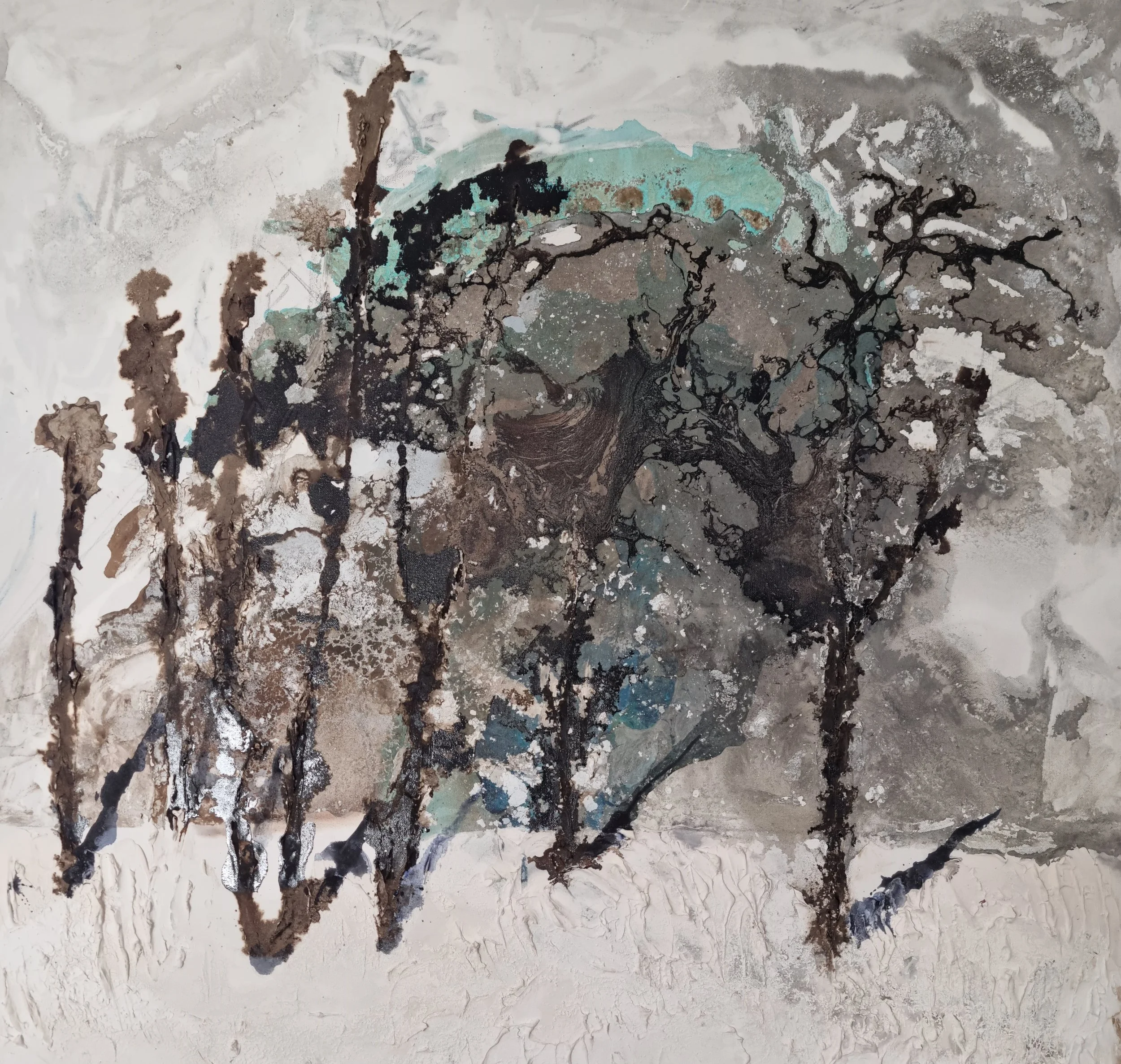
“My practice excavates the material investigation, where the artwork becomes a site of layered processes unfolding over time. At the core of this investigation is industrial cold tar—a primordial substance formed from ancient biomass, carrying geological memory. Tar absorbs light and resists immediate clarity, introducing structural friction and eruption into the visual field. When tar is combined with the fluidity of oil and pigments, merged with stabilizing material as gesso, it produces a tension between contradicting materials (diluted by turpentine and water), this is the basis of the central notion of layering as a structural condition. Each painting develops through successive strata of material interaction: absorption, oxidation, sedimentation, and reactivation. Layers merge, collapse, crack, and reshape, generating forms that cannot be fully predetermined. Layering functions both as a material process and a perceptual model. The strata evoke the body as a layered system, where internal and external states continuously interact. Emotional registers, such as tension, security, and anxiety, are translated into shifts between density, exposure, and movement across the surface. The resulting surface becomes an archive of temporal shifts, evoking the artwork as a layered system in which internal and external states remain in constant flux. This practice is the basis of the Event Horizon body of works dealing with what is hidden and what is revealed in human life. This process aligns with FLY - my broader research framework - which examines how complex systems evolve through the interaction of opposing forces. Within this logic, reality itself is stratified: what we perceive as surface is always the visible threshold of deeper processes. The work is constructed through a sequence of encounters—between control and unpredictability, density and dispersion, concealment and revelation, darkness and light. The concept of Centar operates as a conceptual anchor within this layered field. As a synthesis of “center” and “tar,” it proposes that structure emerges through accumulation and tension around a core. This condition can be observed across scales—from cells and molecules to organs, planets, stars, galaxies, and galactic clusters. Each evolving phase forms a new layer, while each stratum retains the trace of those preceding it—an inscription in time. The center, however, remains dynamic, continuously shifting as new material is introduced. The resulting images evoke cosmological phenomena—nebulae, stellar dispersions, gravitational fields—as structural parallels. Just as galaxies form through the accumulation, collapse, and expansion of stellar gas and dust, the paintings mirror these dynamics at a material scale. The work traces a trajectory from the matter brick stones toward the logic of the universe’s structure.”